Science · Wednesday, November 25, 2026
NASA locks in the design of its nuclear-powered Mars spacecraft
The File desk · Nov. 25, 2026, 1:55 p.m. ET
Confirmed1 primary sourcesAdded 1:55 p.m. ET, Nov. 25
Status
Confirmed. NASA announced the completed design review on November 24, 2026. The review itself took place in October.
- ConfirmedNASA says it locked in key elements of Space Reactor-1 (SR-1) Freedom after a design review at Glenn Research Center in October (NASA, Nov. 24).
- UnverifiedPower level, radiator count and reactor run time: NASA says these are still being evaluated.
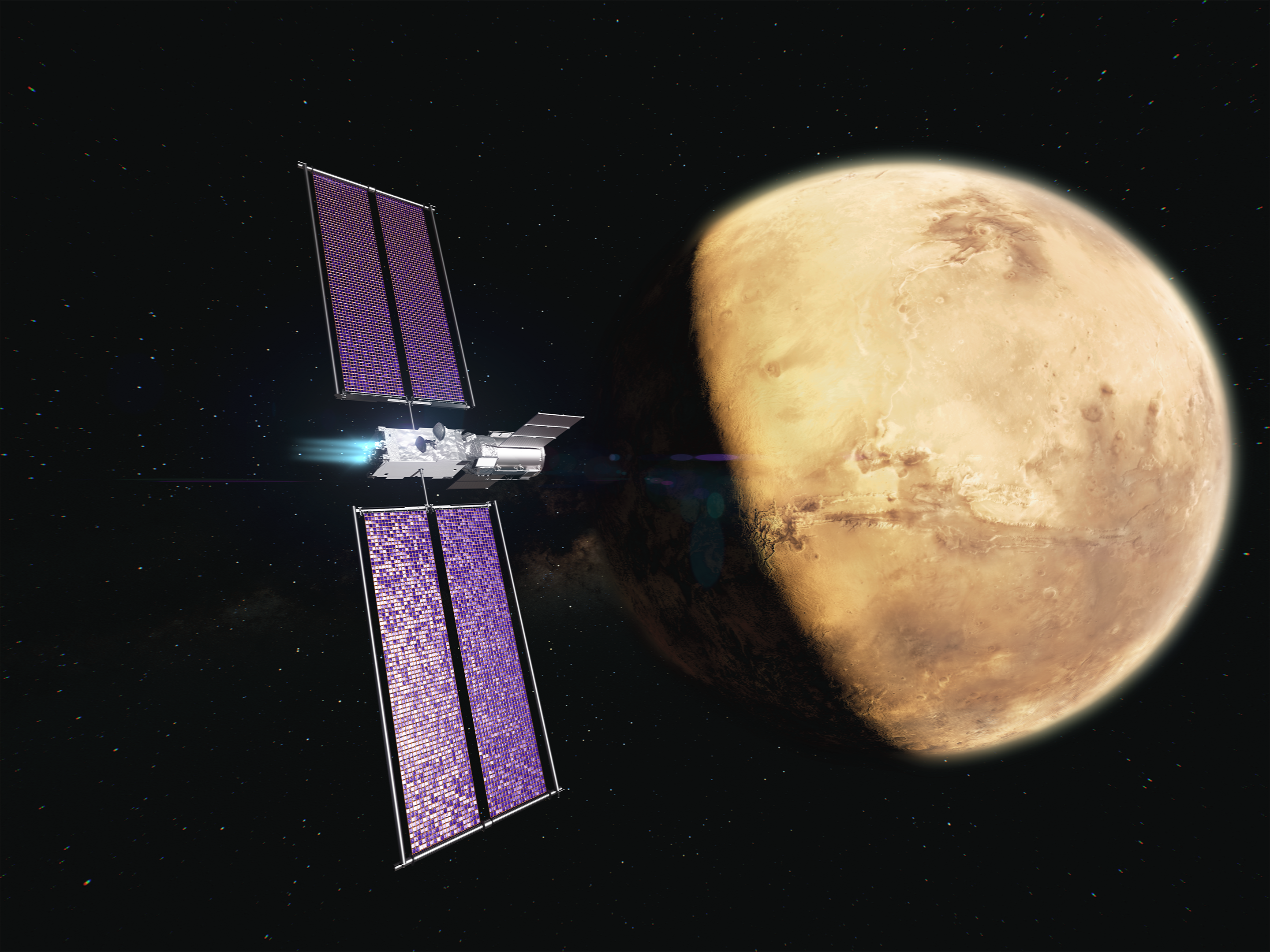
If NASA keeps to its plan, a reactor will power up aboard a spacecraft after it leaves Earth orbit on the way to Mars.1 On November 24, 2026, NASA said it has locked in the main design of that spacecraft, Space Reactor-1 Freedom.1 The decisions came out of a design review held in October at NASA's Glenn Research Center in Cleveland.1 The launch is targeted for late 2028.1
NASA says SR-1 Freedom would be the first fission-powered spacecraft to travel beyond Earth orbit, and the first to demonstrate nuclear electric propulsion in deep space.1 The idea is plainer than the name: a reactor makes electricity, and that electricity drives the spacecraft's thrusters.
The reactor will not run the whole way. As NASA lays it out, the reactor powers up after the craft leaves Earth orbit, runs for a time, then shuts down while solar arrays carry the craft to Mars.1 After the craft delivers its cargo to Martian orbit, it restarts the reactor to collect more data.1
That cargo is a capsule called SkyFall, carrying three helicopters.1 NASA says they will study Martian geology and climate history and search for signs of ice below the surface.1
Two design choices stand out. The boom that separates the reactor from the main body will be shorter than in early drawings, to cut weight and simplify assembly.1 And better shielding will let the reactor sit closer to the rest of the spacecraft while still protecting the electronics and SkyFall from radiation.1 The craft will also get larger X-band antenna dishes to send data home from Mars.1
But notice what NASA has not settled. Teams are still weighing the power output of the nuclear power module, how long the reactor will run, and the number of radiator panels.1 NASA did award a $39.3 million contract to Johns Hopkins University's Applied Physics Laboratory for the system that will shed the reactor's excess heat.1 NASA's announcement gives no total cost for the mission.
So the shape of the spacecraft is fixed. How hard its reactor will work is not.
Why it matters (Estimate). Estimate. Solar panels weaken far from the Sun, so missions deeper into the solar system, and a future base on the Moon, need another power source. A working reactor in deep space would show whether fission can fill that gap. The open questions about power and run time will decide how much this first flight can prove. Whether the late-2028 launch date holds is not yet known.
Three helicopters in a capsule called SkyFall, and a reactor that goes quiet on the way to Mars and starts again once they are delivered. And that is where things stand.
How we know
Notes
- 1.NASA, "Teams Lock in Mission Architecture for NASA's SR-1 Freedom," November 24, 2026. "NASA completed a major review for Space Reactor-1 (SR-1) Freedom and locked in key elements of the spacecraft, which is targeted to launch in 2028 and demonstrate nuclear electric propulsion in deep space for the first time." "Experts from across the agency, the U.S. Department of Energy (DOE), and industry met at NASA's Glenn Research Center in Cleveland for a major SR-1 mission design review in October." "NASA awarded a $39.3 million contract to Johns Hopkins University's Applied Physics Laboratory to develop the heat rejection system." Retrieved by The File desk, Nov. 25. https://www.nasa.gov/general/nasa-locks-in-sr1-freedom-mission-architecture/
What is still unknown or disputed
- The reactor's power output and how long it will run. NASA says these are still being evaluated.
- The mission's total cost. The article gives only the $39.3 million heat-system contract.
- Whether the late-2028 launch date holds.
Primary sources
Every claim in this story is drawn from the documents below. If a fetch failed, that is recorded on the card.
Source 1
Teams Lock in Mission Architecture for NASA's SR-1 Freedom
NASA · November 24, 2026
NASA design review for SR-1 Freedom: key elements locked, launch targeted for late 2028, SkyFall Mars helicopters.
https://www.nasa.gov/general/nasa-locks-in-sr1-freedom-mission-architecture/
Related
Science · Saturday, November 21, 2026
NIH-backed researchers map 58 genetic regions tied to endometriosisScience · Friday, November 20, 2026
Voyager 1 reaches one light-day from Earth, but its data has stoppedScience · Monday, November 16, 2026
Starbase tower arms catch a returning Starship for the first timeScience · Friday, November 13, 2026
Researchers map the brain region that turns thought into action, NIH saysScience · Thursday, November 12, 2026
DeepMind says its new model reads DNA one cell type at a time
Written and checked by AI. How we work: Standards. Corrections